
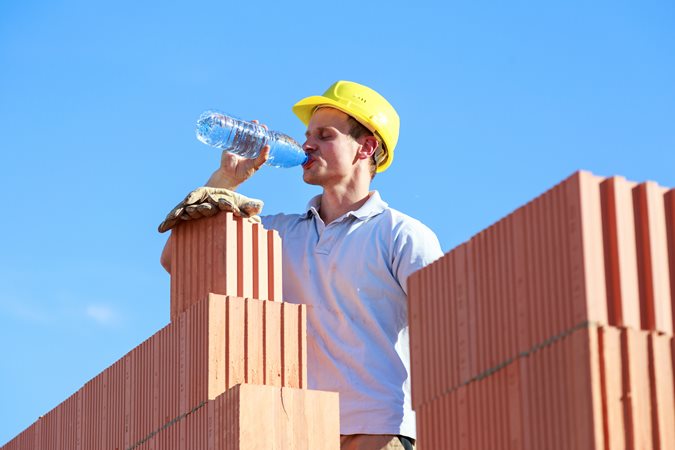
Belgium is officially experiencing a heatwave, which affects your workers, especially if they have to do physical work. What should you consider to keep your workers safe? What preventive steps should you take?
Risk analysis
In general, the Code on well-being at work says that every employer must carry out a risk analysis of thermal environments in the workplace, whether caused by technology or climate, that make working conditions too hot or too cold.
For this, you must consider the combination of the following factors:
- temperature, relative humidity and air movement;
- thermal radiation;
- physical workload;
- methods and work equipment used;
- work clothing and personal protective equipment.
Too hot?
The law sets heat exposure action values measured using the WBGT index. When these values are exceeded, workers risk health problems called heat stress. The action values vary depending on the physical workload.
If the values are exceeded, you must take preventive measures.
|
Max. WBGT index |
Physical workload |
|
29 |
Very light or light work |
|
26 |
Moderate work |
|
22 |
Heavy work |
|
18 |
Very heavy work |
Examples of physical workload:
- Very light work: secretarial work
- Light work: manual work at a table
- Moderate work: work while standing
- Very heavy work: earthworks.
The WBGT index
A simple thermometer is not enough to measure these temperatures. A warm temperature can feel unbearable in very humid weather but may not be a health risk in dry weather. So, humidity must be considered and sometimes also wind speed and direct radiation from the sun or a heat source (for example, an oven).
The WBGT index is measured with a "wet bulb globe" thermometer. WBGT - 'Wet Bulb Globe Temperature' - is an index based on three measured temperatures:
- dry air temperature,
- radiation temperature,
- and wet temperature.
The calculation differs depending on whether the workplace is indoors or outdoors, exposed to sunlight.
If you do not have this device, you can find at this link how to estimate the WBGT using a simple thermometer and a hygrometer.
However, these values are rarely exceeded in shaded workplaces where light work is done, such as offices. These workplaces do not pose an immediate risk of heat stress, but the conditions will be uncomfortable and heat will affect workers' concentration and productivity. For these workplaces, a comfort standard for moderate temperatures applies, the EN ISO 7730 standard. Thermal comfort means a person is satisfied with the temperature and does not want to be warmer or cooler. More information.
Standard NBN EN ISO 7730 "Ergonomics of the thermal environment: analytical determination and interpretation of thermal comfort by calculation of PMV and PPD indices and local thermal comfort criteria".
Preventive measures to take in case of excessive heat from climate
Are the action values (WBGT) exceeded? Then, according to the law, you must take the following measures to avoid heat stress:
- provide free refreshing drinks;
- provide protective equipment (shade screens, hats, sunscreen, etc.) for workers exposed to direct sunlight.
If the high temperature continues for more than 48 hours, you must also:
- install artificial ventilation;
- allow extra rest breaks.
If you want to ensure thermal comfort for your workers during hot summer periods, aim to keep heat complaints below 10%. You can do this by keeping the "PMV" index below 0.5 according to the EN ISO 7730 standard. This index is based on air temperature, radiation temperature, relative humidity, air movement, clothing insulation, and activity level.
To measure it exactly, special devices are needed, but for seated workers wearing light clothes in Belgium, this usually means a target temperature between 24 and 26°C (normal air temperature).
During very hot periods, a short exceedance (max. 10% of the working day) is still acceptable. Be sure to consider the following points:
- To reduce heat from radiation, use blinds (preferably outside the building).
- Do not set air conditioning too low (max. 6°C lower than outside) to avoid big temperature differences and drafts.
- Choose light, breathable clothing (uniforms).
- If possible, change working hours to avoid the hottest part of the day. For example, ask workers to start earlier or finish later temporarily. More information on adjusting schedules, click here.
- Encourage workers to drink enough water (preferably caffeine-free or unsweetened) and provide ways to keep drinks cool.
Ozone and outdoor workers
Remember that during hot periods, high ozone levels are common. The well-being law does not cover ozone exposure from climate, but it is a risk that needs preventive measures. Some people are more sensitive: pregnant women, elderly people, and those with respiratory or heart problems.
Since ozone levels are lower indoors, pay more attention to outdoor workers. Measures you can take include:
- do heavy physical work only in the morning, when ozone is lowest;
- do lighter work to reduce breathing rate and ozone intake;
- provide rest breaks indoors.
You can check forecasts from the Interregional Environment Cell (CELINE – www.irceline.be) to know when to apply these measures.
What can Securex do for you?
Would you like more information on measures to take during high heat? Read our brochure or talk to your occupational physician.
If you want to carry out a WBGT measurement, contact your external service for prevention and protection at work at health-safety@securex.be.
.jpg?width=725&resizemode=force)